
Turku City Hall is located on the bank of Aura River. It was completed in the corner of Aurakatu and Läntinen rantakatu in 1812. The City Council of Turku, which was established in 1874, has convened at the City Hall since 1885.
The City Hall was originally built as restaurant Seurahuone in 1811–1812. The design drawings were prepared by Charles (Carlo) Bassi, who acted as the manager of the public building administration at the time.
The opening ceremony of Seurahuone, celebrated with a masquerade ball, was held on 22 November 1812. At the time, Seurahuone was the centre of Turku nightlife, a meeting place for the gentry, where many kinds of parties, balls, plays and concerts were held. It also offered accommodation for travellers.
In addition to the City Hall, there are several other buildings protected by law in the block. The log houses around the courtyard date from the 18th century and the stone houses from the 19th century. The park in front of the City Hall dates back to the times of Seurahuone.
A local detailed plan was first drawn up and implemented for the area of the city hall block (the so-called Herrainkulma area) in the mid-17th century. Since then, there was urban settlement in the area until the 19th century.
The city renovated the facilities for its own use
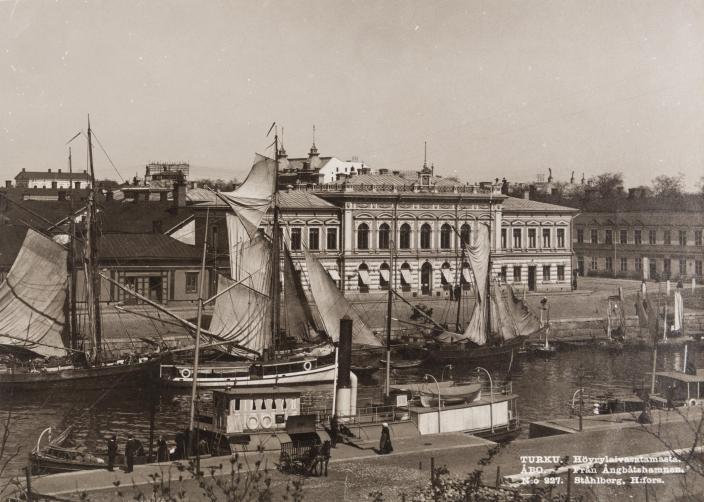
The ownership of the building and its plot were transferred to the City of Turku in 1878. At the time, the town hall facilities in Brinkkala had become insufficient and the city greatly needed additional space. At first, it was even proposed that the old building be demolished to make room for a new one, but eventually, a decision was made to renovate the existing building.
Following Bassi’s design, the two-storey stone house originally had a simplified expression of form in accordance with Swedish Neoclassicism. In the renovation project, the façades and interiors were transformed into Neo-Renaissance style.
The renovation was led by architect Frans A. Sjöström. Sjöström also changed the main entrance, where a decorative iron canopy was built above the three front doors. In fact, there is very little left of the original outward appearance of the building.
The second floor of the building was renovated to serve as the session hall, offices and banquet facilities of the city council. An auction room, customer service facilities of a restaurant and business premises were placed on the lower floor. After thorough renovation of the interiors and the exterior, the building was reopened in 1885.
A proper council hall for the City Council in the 1960s
In 1921, the lower floor of the City Hall was refurbished for the use of the city court (which later became the district court), and the local register office was placed in the smaller hall upstairs. The local register office operated in the building until 1975 and the district court until 1997.
The City Hall has undergone numerous changes during its life cycle. The most significant of them include the renovations carried out in 1909–1910 and 1964–1965.
In the renovation made between 1964 and 1965, the banquet hall was transformed into a permanent council hall. After the district court moved from the building in 1997, it was completely renovated for use of the City Council. At the same time, a new glass-walled entrance with lifts was made between the southwest wing of the building and the annex.
Text continues after image

The whole block will be renovated
The foundations of the City Hall and the buildings surrounding it have been found to be sinking at an accelerating pace. In May 2024, the City Board adopted an extended project plan for the City Hall and the block. In the renovation, the foundations of the sinking buildings will be reinforced. At the same time, the yard areas of the entire block will be renovated.
The city will renovate the City Hall and the buildings around it between 2025 and 2028. In addition to the City Hall, the project includes six protected buildings and one new building and the yard area. The repairs will be carried out in cooperation with the Turku City Museum.
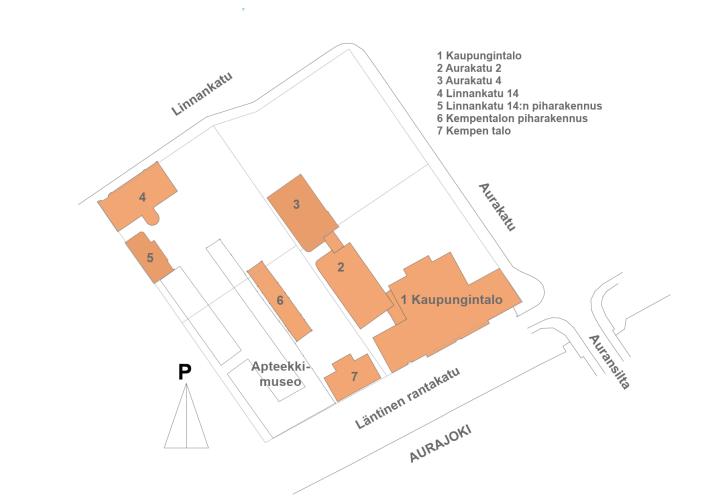
In December 2023, the city residents were asked about their views of the City Hall yard and their wishes for developing it through the Tell Us Your Opinion survey.
The survey revealed that most respondents wanted the prestigious park to be a peaceful area where people could come to spend time: more flower beds and greenery, and parking away from the block.
In their comments, the city residents wanted the block to become a more pleasant environment. The main wishes were that the trees would be preserved and more greenery planted. Most of the respondents hoped that the yard area would become a peaceful place where people could spend time or stop for a moment. In particular, they requested improvements to lighting and more seasonal lights. Most respondents hoped that the dignity and history of the area would be better highlighted.
Extensive archaeological excavations
Major archaeological excavations will be carried out in the city hall block and in several different buildings. The excavations will continue until 2026. They will be extensive and focus on the interior parts of the buildings.
In terms of surface area and cubic metres of excavated soil, this will be one of the largest excavations ever in the centre of Turku. At a later stage of the project, some of the yard areas will also be studied more extensively.
The aim is to restore the dignity of the area
The aim of the renovation of the block is to restore the yard area of the City Hall to a built environment of cultural and historical value and a pleasant meeting place for city residents.
The block is an integral part of the public urban space of historical Turku, which includes the sections of Läntinen and Itäinen Rantakatu, Vähätori square and the Old Great Square. The park surrounding the City Hall will be completely renovated and it will be put into the kind of use as a pleasant public urban space that it deserves.
One of the goals is to build a natural passageway from the Market Square and Hansakortteli to the riverbank through the city hall block. With the exception of parking spaces for service traffic and persons with reduced mobility, all other parking will be removed from the yard.
The City Council will return to the City Hall in 2029
The City Hall will return to its current use as a meeting place for the City Council and decision-makers once the renovation has been completed. Until then, the council will convene in the premises of the Linnasmäki College.
After the renovation, as many workstations for the city personnel as possible will be centralised in the city hall block and Sampotalo, located on Yliopistonkatu 27. This will enable the city to give up many of its rental facilities.
Turku City Hall to be renovated again
- Built as a hotel-restaurant in 1812
- Ownership transferred to the City of Turku in 1878
- City Council meeting venue since 1885
- The renovation of the entire block will be carried out in 2025–2028