
“Turku has become the most maritime city in northern Europe. Ten kilometres of shoreline have been opened up to city residents; the sea is accessible to everyone. The green area has attracted many new residents and companies, and it is easily accessible to tourists.”
Urban Planning Director Timo Hintsanen uses these words to describe how the districts of Pansio, Perno and Artukainen could look in the future, if the city proceeds according to the Turku Maritime City Vision published in summer 2024.
The objective of the vision has been to illustrate a possible future where the freight port does not dominate most of the shoreline, but Turku is growing towards the sea instead. It expands upon the reflections sparked by the vision for the city centre of Turku, the Linnanniemi idea competition, the port’s joint terminal project, and the further planning of Linnanniemi.
Hintsanen has been in charge of preparing the vision, involving numerous experts, representatives of various stakeholders and input from local residents.
Do you want to go swimming in Pansio?
Deputy Mayor Elina Rantanen, who has served as the chair of the vision’s steering group, also emphasises that the vision positions Turku as a true seaside city.
– Urban development has been moderate for a long time in Pansio, Perno and Artukainen. This would mark the beginning of real progress in the area.
The future vision looks ahead, reaching as far as the 2070s, but some steps could perhaps be taken in the next few years.
– We are currently investigating the possibility of establishing a beach in the middle of the current Pansio harbour area, and a park around it. This would mark the first step in a major transformation, Rantanen says.
Text continues after image

Good life for residents and businesses
In the vision, a dozen new neighbourhoods will be created in the area, connected by green spaces. The operating conditions of Pansio’s naval base will be safeguarded. Artukainen will continue to have a sports centre in the future, but space will also be allocated in the area for companies relocating from the shoreline, as well as for new businesses.
Rantanen gives tangible examples of the expansive vision for the future:
– There will be a bakery café on the beach where you can rent boats and head towards the archipelago, or perhaps go paddling along the River Raisionjoki. Nature will be part of the built environment, and there will be countless places for jogging everywhere. The region provides outstanding conditions for a happy life.
Text continues after image

Guidelines instead of finalised plans
Hintsanen emphasises that the plan does not consider the potential future location of the freight port if Turku grows towards the west. Public conversations have highlighted the Viheriäinen area of Raisio and the shoreline of Neste as potential new locations.
– We are not planning to evict the freight port. We focus on long-term solutions. It is important that we have guidelines for the development of the area if one day we wish to implement a modern port solution in Turku. Specifically, the vision offers ideas and suggestions, rather than complete plans ready for execution, Hintsanen emphasises.
Beaches belong to people
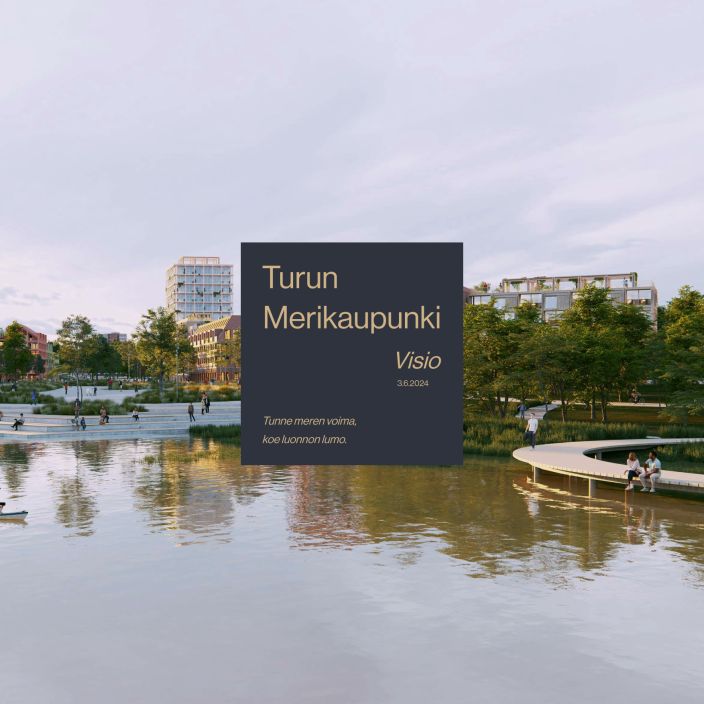
Architect Ted Schauman has made the greatest effort to translate the vision into a compelling and tangible visualisation. He says that experiences from other Nordic countries have also inspired the efforts.
– Copenhagen, Oslo, Helsingborg and Malmö have grown towards the sea and spread to old harbour areas. The shorelines have become accessible to the public, and people now visit the new, pleasant neighbourhoods during their leisure time, even from afar. All this is possible also in Turku, he says.
Turku’s recent history provides an interesting reference point for the attractiveness of the shoreline, or, in this case, the charm of the riverbank. At the beginning of the 1980s, the River Aura was just a river, not particularly inviting to anyone. When the area began to develop, the riverbank became the heart and pride of the entire city, the summer living room of Turku residents.
TEXT: MATTI VÄLIMÄKI
The article was published in Turkuposti 2/2024.
- The creation of a future vision for the maritime western Turku is part of the implementation of the Mayor’s Programme.
- On 22 June 2023, the Turku City Board decided to begin preparations for the future vision and established its goals.
- Turku Maritime City Vision was published on 3 June 2024. (Publication is in Finnish)
- The City Board approved the vision to serve as a guideline on 20 June 2024. At the same time, a decision was made to immediately begin planning an area called Oravainen Beach Park, and to conduct a preliminary investigation of the new beach in preparation for drafting a detailed plan.