
Creativity, opportunities for participation and long-term collaboration promote the circular economy alongside knowledge. During the three-year Creative Circular Cities project, the circular economy was brought closer to the everyday lives of Turku’s residents through culture and the creative sectors.
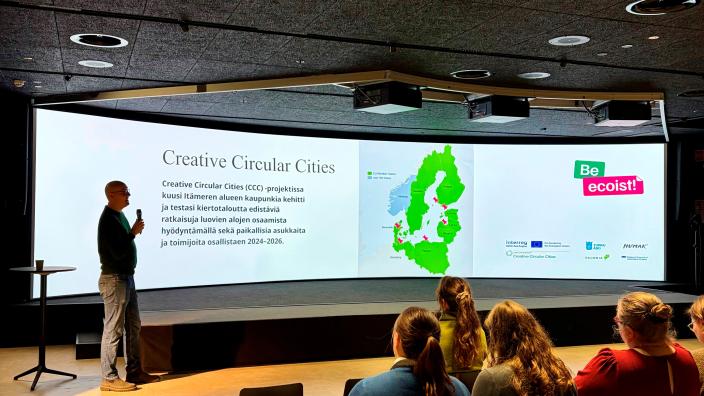
As part of the international Creative Circular Cities (CCC) project, six cities in the Baltic Sea region developed and tested solutions to promote the circular economy between 2024 and 2026. The work drew on expertise from the creative sectors and involved local residents and stakeholders. The Turku sub-project was carried out by the City of Turku, Valonia – the sustainable development expert organisation of the Regional Council of Southwest Finland – and the Turku University of Applied Sciences. The results will continue to be utilised in the city’s and its partners’ circular economy work even after the project has ended.
The trials showed what inspires people to get involved
In Turku, lessons were learnt from the ReTurku circular economy carnival, a cross-sectoral ideas workshop, a bio-waste competition that utilised expertise from the creative industries, and two digital service pilots. Participants included residents, businesses, organisations, higher education institutions, professionals from the creative sectors and city experts.
The key lesson from the trials was that information alone does not change behaviour. Art, culture, events and collaborative activities can make the circular economy understandable and engaging, whilst offering low-threshold ways to get involved.
– The circular economy does not necessarily become part of everyday life through knowledge alone. Insights, encounters and opportunities to get involved are also needed. The project has left Turku with working models and new partnerships that will help to continue the transition to the circular economy, says project coordinator Emil Kusnetsoff.
Trials of digital services provided insights into how local circular economy services could be more easily integrated into people’s everyday lives.
Tools, operating models and networks remain in Turku
The experiences gained from the idea incubator, events and competitions can be utilised as the city and its partners plan new ways to involve residents in circular economy initiatives. At the same time, the connections forged during the project will strengthen collaboration between the circular economy and the creative sectors. The ‘Circular Economy and Culture’ morning coffee sessions, organised during the project and continuing thereafter, strengthen collaborative working across the city’s various service areas.
- Models for participation: the experiences gained from the idea incubator, the ReTurku circular economy carnival and the bio-waste competition can be utilised in new projects and the city’s operations.
- Materials to be retained: ReTurun guide: ‘How to make the circular economy visible, inclusive and inspiring’, microcourse on cross-sectoral innovation and the international CCC Starter Kit support the continuation of this work.
- Collaboration networks: Circular Economy and Culture morning coffee sessions strengthened links between the city, the creative sectors and circular economy stakeholders.
The project is coming to an end, but the lessons learnt will be put into practice
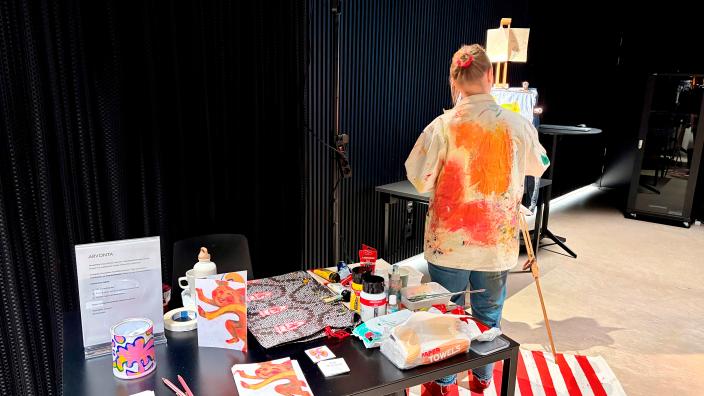
The closing seminar for the project, which ends in October, took place on 19 October in Turku, bringing together perspectives on the circular economy, culture and creative business. The opening address was given by the EU Climate Ambassador and Executive Director of the Finnish Natural Heritage Foundation, Timo Huhtamäki. Visual artist Elli Maanpää’s live painting on a second-hand denim jacket demonstrated how art can make the circular economy visible and spark discussion.
Models that have proven effective have been adopted and are being integrated into the ongoing circular economy work of the city and its partners. Ultimately, promoting the circular economy is about changing mindsets. Change does not happen overnight; it requires time, open communication, cooperation between different stakeholders and the courage to try out new solutions.
“Creative Circular Cities” is a project co-funded by the EU’s Interreg Baltic Sea Region programme, which aimed to promote the transition to a circular economy at a local level through the involvement of the cultural and creative sectors and industry.
This translation was produced with AI and reviewed by a human.
