
1. Managed growth
Where are we now?
Where are we heading during the 2025–2040 strategy period?
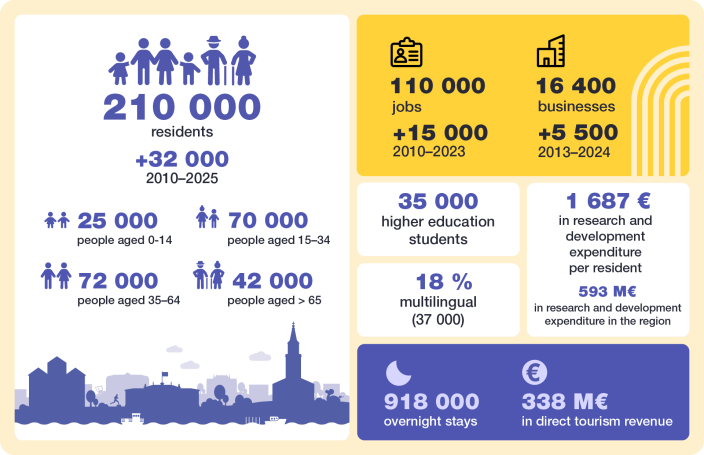
Turku has moved from a period of slow and steady growth to a period of rapid growth associated with urbanisation. Growth is comprehensive and extends across many areas. Growth is not just about numbers; it is a direction that is visible in and affects the everyday lives of Turku residents. Growth creates a new, vibrant, diverse and changing city around it. The logic of growth is that people, expertise, higher education institutions and businesses attract more people, jobs and expertise. Growth is managed, guided and led using data.
Strong municipal finances are a prerequi-site for the city to be able to invest in services, make the investments necessary for urban development and keep residents’ tax burden at a reasonable level. Turku invests in a sustainable future. Investment priorities and overall levels are determined through investment programmes and annual financial planning and management. Urban development is realised through investments, which respond to the city’s growth, vitality and changing service needs. As is characteristic of investments, the financial burden comes first, while the positive impacts materialise later. Turku’s revenue base is strengthened by improving the city’s vitality, particularly by promoting business and job growth and attracting businesses to the city. Decisions take into account Turku’s future competitiveness and the need to encourage work, skills development, innovation and entrepreneurship.
Turku pursues an active ownership policy that supports the city’s finances and vitality and increases the value of its holdings. The need for services and investments is growing, but central government transfers are not increasing at the same rate. Operational and financial objectives are set so as to safeguard balanced city finances and sustainable levels of debt and liabilities over the medium term. Balanced finances are achieved through budgets, the long-term financial plan and investment programmes. Sustainable finances require the ability to make choices and set priorities.
Turku supports the conditions for growth and prepares for future growth while actively managing it. We invest in a good life for Turku residents, a smoothly functioning everyday life and good relations between population groups. Growth requires proactive preparation, particularly for population growth driven by immigration and an ageing population. At the same time, we ensure investment in pleasant living environments and the quality of housing. Economic and population growth alone do not define the city’s success; we also take the wider impacts of growth into account. We aim to create a positive cycle of growth in which changes reinforce one another.
Together with key partners, we enable growth in jobs, businesses, investment, research and development expenditure, and tourism. By 2040, Turku aims for growth of at least 30,000 residents, 15,000 jobs, 6,500 businesses and 500 startups and growth companies. The targets also include increasing research and development expenditure to EUR 800 million, strengthening the retention of higher education graduates and doubling tourism revenue. We invest in promoting employment and reducing structural unemployment in cooperation with the em-ployment area.
We attract investment and growing companies and promote the creation and growth of new businesses in cooperation with key partners. We support businesses in locating in Turku by providing plots and business premises and through planning, plot allocation and permitting. We ensure that education and skills development meet the needs of Turku’s industries and growth sectors, such as the maritime and pharmaceutical industries. We harness sustainability-related business and investment opportunities, as well as green transition and blue economy solutions, to attract investment and businesses. Measures to enable growth, promote employment and attract investment and businesses will be defined in detail in the Growth and Vitality Programme currently under preparation.
Turku is a respected university city with a long tradition. All our higher education institutions operate internationally. We support their attractiveness, cooperation and international networks. We ensure that Turku remains among the three most popular student cities and develop student life and campus areas. We deepen cooperation particularly to strengthen the attraction and retention of talent and research, development and innovation activities. We invest in strengthening the retention of international talent in cooperation with higher education institutions and other stakeholders. We recognise the importance of the Swedish-language university in Turku and the Swedish-language study pathway for the city’s ability to attract and retain talent.
Culture strengthens Turku’s vitality and is a key competitive factor. Opportunities for culture are expanded throughout the city, not just in the city centre. The creative industries are a significant source of employment and strengthen the identity of different areas. Cultural life, the arts community, sports clubs and recreational organisations are a major resource for the city. Turku strengthens its position as an attractive bilingual city of culture and leverages this in its marketing and efforts to increase visibility both nationally and internationally.
Internationality is a key part of Turku’s Growth Story. For us, internationality is not a separate matter; it permeates everything we do and is part of our identity. An international mindset helps us better understand future trends. We position ourselves as a bilingual Northern European city of culture, climate and nature. Turku’s most important international arenas are the Nordic countries, the Baltic Sea region and Europe. We invest in tourism growth, major events and cooperation with tourism and restaurant-sector operators. We leverage Turku’s 800th anniversary year in marketing and place branding and in strengthening the city’s visibility.
Turku and the Turku region succeed together. We strengthen cooperation with municipalities in the city region and seek joint solutions for developing a sustainable and equitable urban structure. Shared objectives are defined in the regional strategy and MAL planning. The aim is for the Turku city region to rank among the three most competitive city regions by key indicators in 2040.
Strategic impact objectives for the 2025–2029 City Council term and the medium term 2025–2040
(The baseline and target levels for the indicators will be defined separately during implementation for the City Council term and the medium term.)
- The city’s finances are balanced.
- The number of residents, jobs and businesses increases.
- Research and development expenditure increases.
- The number of startups and growth companies increases.
- The retention rate of higher education graduates in Turku increases.
- The employment and unemployment rates are competitive compared with other cities with more than 100,000 residents.
- The number of visitors and tourism revenue increase.
2. Community sustainability
Where are we now?
Where are we heading during the 2025–2040 strategy period?
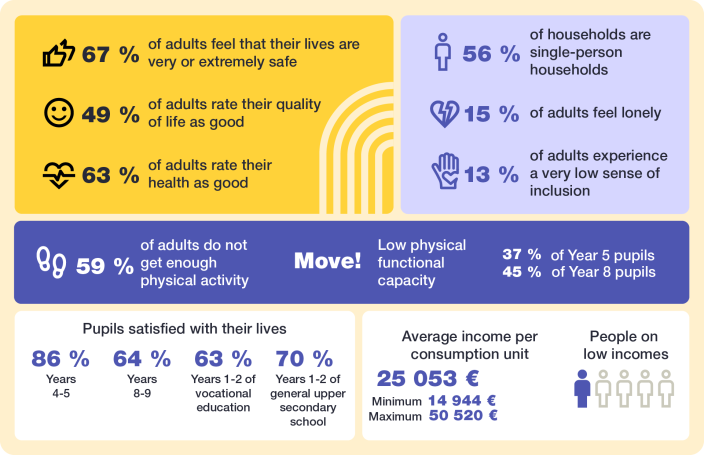
Turku is a city for children and young people, offering a high-quality learning path for people of all ages. We take a comprehensive approach to strengthening the wellbeing of children and young people. We invest in learning support, addressing disruptive behaviour and safety. Our activities are based on research, and learning outcomes are improved by using learning analytics and new support structures. We monitor the regional model for children and young people and utilise the information it produces. We ensure that every child and young person is seen and heard. The aim is to strengthen the literacy skills of all children and particularly to support language learning among young people with an immigrant background. We strengthen older people’s functional capacity, the participation and equal opportunities of people with disabilities, and a sense of community.
We target models for recreational activities, participation and community engagement based on need, by residential area and target group. In the School as a Platform model, physical activity and cultural experiences are part of everyday life both during and after the school day. We develop opportunities for recreational activities on school premises and strengthen the Finnish Model for Leisure Activities. We prevent school segregation by supporting local schools, improving basic skills and ensuring equal opportunities throughout the city. We act as a pioneer in child impact assessment across different sectors and levels of decision-making. We continue to plan the service network based on need. We ensure that services are accessible throughout the city. Investments in premises are allocated, as needed, to new day-care centres, schools, multipurpose buildings and meeting places. At the same time, we ensure that the existing network of premises provides healthy and safe conditions and is up to date.
We reduce disparities in health and wellbeing between different population groups, residential areas and age groups. Wellbeing is supported through preventive measures and by increasing opportunities for participation. The aim is a smoothly functioning everyday life, an accessible environment and strong local communities. Homelessness will be eliminated by 2040. The impacts of decisions are monitored using data, including the regional segregation index and the new resident barometer. We deepen cooperation with the wellbeing services county and organisations, particularly in services for older people and people with disabilities and in strengthening participation. Digital and online services are developed with a customer- and resident-oriented approach.
The wellbeing of Turku residents is a prerequisite for a vibrant city. A physically active lifestyle, culture and a sense of community strengthen wellbeing and help everyday life run smoothly. Preventive wellbeing measures, such as increasing physical activity, providing early support and strengthening a sense of community, support residents’ ability to work and function and represent a significant investment in the city’s financial sustainability. Sports and cultural services and opportunities for recreational activities are developed together with sports clubs, associations and other partners. Low-threshold services as well as major events, exhibitions and productions are accessible throughout the city. We focus on developing the network of sports facilities, regional multi-purpose buildings, play and recreation areas in residential areas, local libraries, the cycle path network, parks and urban woodlands, as well as low-threshold events and cultural offerings.
We invest in helping new Turku residents settle in and learn the language. Turku is a home for everyone, regardless of background. Language must not be a barrier to becoming part of the Turku community. We develop services that support smooth integration and strengthen the commitment of international talent, students and businesses to the region. We invest more in Swedish-language communications, increase the city’s communications in English and other languages, and also provide information in plain language. We promote equality and recognise the need for anti-racist measures within the city’s structures.
We strengthen the city’s approach to safe-ty and crisis resilience, as well as the safe-ty of residential areas, residents’ attach-ment to their neighbourhoods and their sense of security. We prepare for disruptions and emergency conditions together with other actors. We proactively develop risk management within the city and the City Group.
Strategic impact objectives for the 2025–2029 City Council term and the medium term 2025–2040
(The baseline and target levels for the indicators will be defined separately during implementation for the City Council term and the medium term.)
- Learning outcomes among children and young people improve and regional disparities in learning outcomes narrow.
- The wellbeing of Turku residents increases.
- Resident experience: residents’ satisfaction with their own residential area increases.
- The coefficient for the promotion of health and wellbeing (HYTE) increases.
- Regional segregation decreases.
- A physically active lifestyle and culture become part of everyday life for an increasing number of people.
- Development of visitor numbers at selected cultural attractions and libraries.
3. Good urban life
Where are we now?
Where are we heading during the 2025–2040 strategy period?
Strategic urban development projects strengthen Turku’s vitality and its ability to attract and retain people and businesses, while also increasing the city’s attractiveness. Hard investments are directed at strategically significant urban development projects in accordance with the visions and plans drawn up for them. Soft investments involve developing day-care centres, schools and multipurpose facilities, as well as opportunities for sports and culture, for a growing and increasingly multilingual population. Soft attraction factors, such as wellbeing and the quality of the living environment, are playing an increasingly important role in the location decisions of both residents and businesses.
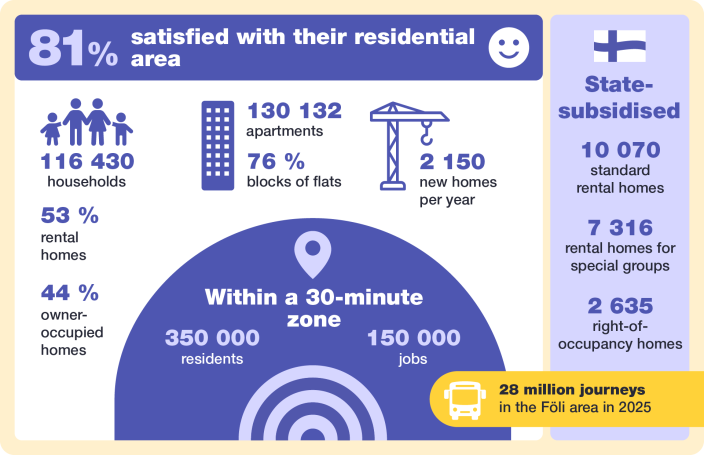
Good urban life is built on pleasant residential and living environments, which are developed through carefully considered housing policy and land-use choices that respect local architectural heritage and nature. Turku’s housing policy and land-use guidelines will be revised at the beginning of the strategy period. The guidelines will ensure a diverse supply of housing for different stages of life and a balance between owner-occupied and rental housing. The aim is to strike a balance between density, greenery and living space, taking particular account of the diverse needs of families. At least one quarter of new homes will be family homes. We will strengthen Turku’s family-friendliness so that families with children also want to live in the city. This requires a diverse and affordable supply of family housing. We will increase the supply of owner-occupied homes as well as detached, terraced and semi-detached houses in selected areas. We will promote an adequate supply of plots for detached houses and the conditions for a smoothly functioning everyday life. In our housing policy, we prepare for an ageing population and the needs of special groups. Turku must also be an attractive place to live for older people in terms of services, housing, meeting places and mobility. We will avoid concentrations of state-subsidised housing or unregulated rental housing.
Planning and housing policy are used to promote a mixed and diverse housing stock and a sustainable urban structure. Planning and permit processes will be accelerated, particularly at stages that are not required by law. Interaction between city actors will be increased, understanding of the needs of businesses will be strengthened, and feedback received will be used more effectively in decision-making. Infill development will primarily be directed to existing plots in order to preserve nearby natural areas. Green environments and biodiversity will be safeguarded in the planning of new areas and in infill development. Policies on subsidised housing will be defined as part of the housing policy reform. Options for the city’s own financing will be explored together with other large cities. Cooperation will be deepened with housing providers within the City of Turku Group (TVT, TYS and Vaso) and other actors. Market-based affordable housing will be promoted to reduce pressure on price-regulated housing.
In Turku’s Growth Story, the city centre is the hub of housing, jobs, services and events, as well as the city’s calling card. Alongside the city centre, other residential areas will be developed equitably, taking their distinctive characteristics into account. The principles of the City Centre Vision 2050 will be further developed through an action programme bringing together the key development projects for the strategy period. We encourage residents to contribute to the development of their own residential areas. A sense of community will be strengthened through various events in cooperation with local actors such as libraries. The riverfront is a key feature that sets the city apart and forms part of the development of the expanding city centre. The potential of the Art House Turku, Music Centre Fuuga, the renewed WAM and the entire cultural riverfront will be harnessed to enhance the attractiveness of the city centre.
Good accessibility and smooth transport connections are key competitive factors for Turku and the city region. Turku takes the needs of different transport user groups into account and prioritises walking, cycling and public transport. On the busiest routes, solutions will be implemented that support a well-functioning urban structure, pleasant urban spaces and sustainable mobility. We will develop the public transport corridor, particularly between the port and Varissuo, as well as transport conditions in accordance with existing plans. Föli serves as the regional backbone of smooth everyday mobility.
We invest in developing transport hubs and connections and improving accessibility by road, rail, air and sea. We will ensure the implementation of the first and second phases of the West Railway and promote the launch of local rail services. Together with other actors, we will explore a joint Nordic transport and growth corridor from Helsinki via Turku to Stockholm and onwards to Oslo and Copenhagen as part of the EU’s strategic objectives.
Strategic impact objectives for the 2025–2029 City Council term and the medium term 2025–2040
(The baseline and target levels for the indicators will be defined separately during implementation for the City Council term and the medium term.)
- Resident experience and satisfaction with their own residential area increase.
- Housing production and the number of permits granted increase.
- The number of family homes increases.
- The supply of plots for detached houses and the number of detached houses increase.
- The vibrancy and vitality of the city centre increase.
- The modal share of sustainable mobility in journeys within Turku increases.
- The number of Föli public transport users increases.
4. Leading through nature
Where are we now?
Where are we heading during the 2025–2040 strategy period?
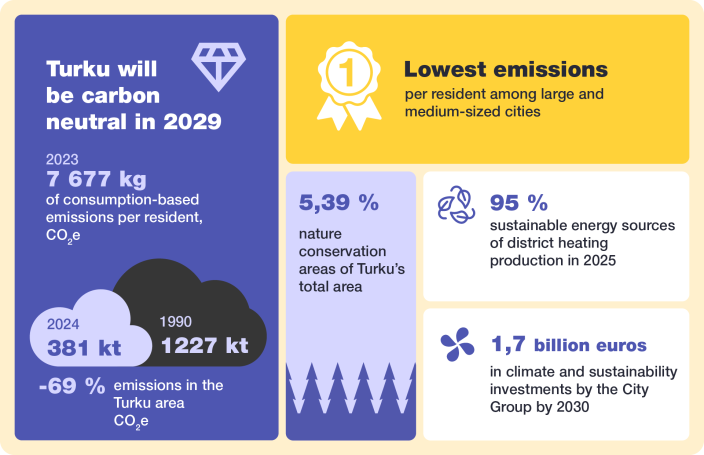
Turku will be carbon neutral in 2029 and a resource-wise urban area by 2040. The aim is to become an emission-free, waste-free city that uses natural resources sustainably. The objectives and indicators will be updated as necessary to reflect national and international policies. In Turku, objectives related to sustainable growth, a just transition, climate change mitigation and adaptation, and biodiversity are reconciled in cooperation with partners, stakeholders and residents. The city prepares for the impacts of global warming and extreme weather events.
In Turku’s Growth Story, climate, nature and resource wisdom objectives are systematically put into practice. Solutions are based on data and simultaneously support the regional economy and society’s crisis resilience. The climate partnership harnesses the expertise of businesses, research organisations and networks to develop new nature and circular economy solutions. At the beginning of the strategy period, the Climate Plan and Circular Economy Roadmap will be updated and a roadmap for a nature-positive Turku will be prepared. They will be widely integrated into the activities of the City Group, higher education institutions, businesses and communities. The Biodiversity Programme (LUMO) will be updated for 2030–2038. The energy transition will be completed and the energy system will be developed to become climate positive. Sustainable construction solutions will be promoted.
Climate and nature objectives guide transport and mobility solutions in a lower-emission, smoother and healthier direction. This is steered through land-use planning and financial planning. Transport emissions are reduced by developing a sustainable transport system, promoting walking, cycling and public transport, and utilising electric and autonomous transport solutions. Sustainable construction emphasises urban greenery, stormwater management and nature-based solutions.
Climate and nature objectives make the urban environment greener and more pleasant while supporting residents’ health and the city’s attractiveness. Greater density will not be pursued at the expense of greenery. Land-use planning and the urban structure will be used to improve preparedness for extreme weather events as well as emergency and crisis situations. Attention will be paid to emissions from construction and demolition. Turku will primarily seek to avoid harm to nature, then mitigate any harm that cannot be avoided, and compensate for unavoidable harm. Green areas, ecological connections, nearby forests and cultural landscapes will be safeguarded. Green structures, including green walls, roofs, balconies and decks, will be diversified. In the city’s construction and planning, the aim is to bring nature and trees close to every resident in accordance with the so-called 3–30–300 principle.
Turku will play a leading role in protecting the Archipelago Sea and the Baltic Sea together with central government and partners. The unique nature and biosphere of the archipelago will be taken into account in all decision-making. Turku will make the Archipelago Sea more accessible by developing tourism in the area in a sustainable manner.
Strategic impact objectives for the 2025–2029 City Council term and the medium term 2025–2040
(The baseline and target levels for the indicators will be defined separately during implementation for the City Council term and the medium term.)
- Turku’s consumption of natural resources and emissions decrease.
- Adaptation to climate change is strengthened.
- Territorial and consumption-based greenhouse gas emissions decrease.
- The circular economy is strengthened in the Turku urban area.
- Biodiversity and ecosystems in the region are strengthened.