
The history of the Old Great Square dates back to the Middle Ages, when it served as a bustling marketplace, an administrative centre and a key transport hub. The City of Turku continues to develop this unique cultural environment by renovating the area’s protected buildings.
All Roads Led to the Old Great Square
For centuries, the Old Great Square was a junction of Finland’s most important roads and transport routes. The Viborg Coastal Road, routes from Satakunta and the Häme Ox Road all intersected at the Square. This junction shaped the Square into a centre not only of trade, but also of communication and movement.
Travellers, merchants, officials and local residents met at the Square, while merchant vessels and boats from the archipelago moored nearby. The Square’s close connection to the Aura River enabled the smooth transport of goods by ship, further reinforcing its role as a hub of commerce.
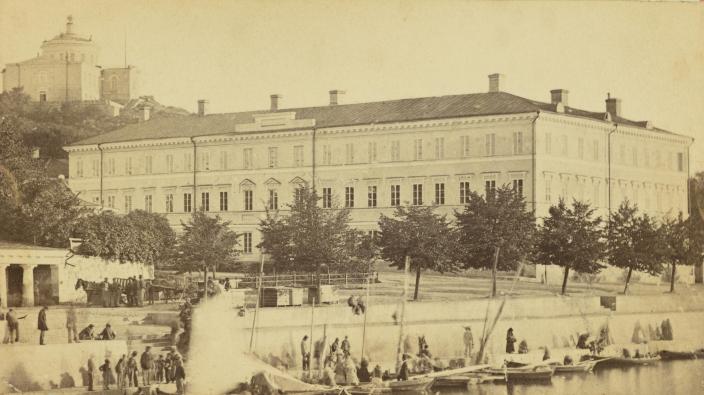
The Great Square Becomes a Centre for Trade and Administration
The layout of the Great Square dates back to the Middle Ages, as do the cellar spaces and, according to records, parts of the wall structures on the lower floors. As the city grew, the square increased in both importance and size. In the 15th century, a bridge was built linking the road from the north to the Great Square, and gradually urban settlement spread to the northern bank of the river.
The area was later expanded to the western bank of the Aura River, now known as the Small Square. The proximity of the Old Great Square to Turku Cathedral strengthened its role as both a secular and spiritual meeting place.
The buildings that today surround the Great Square were constructed between 1735 and 1901. The stone buildings gave the area a dignified appearance, which is still evident in the Old Town Hall, Brinkkala Mansion, Hjelt Mansion, and Juselius Mansion.
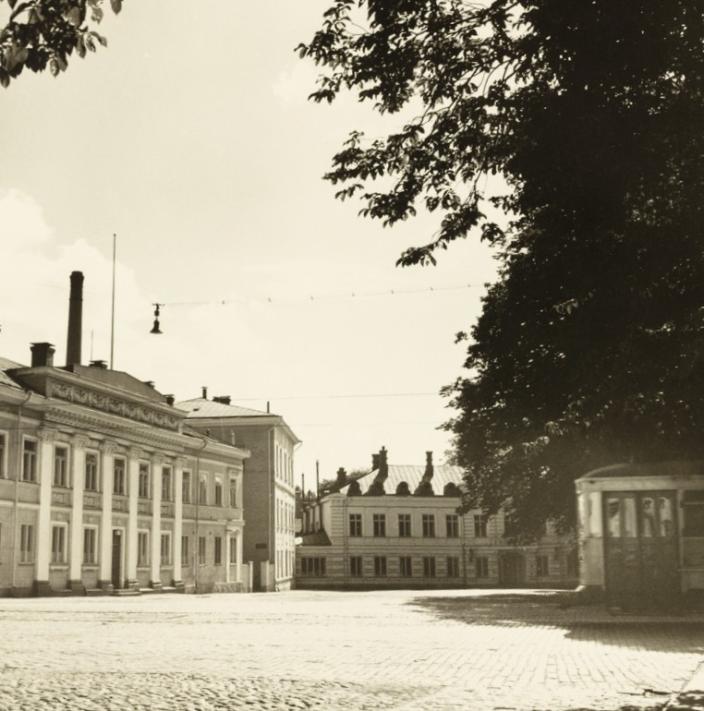
The Great Fire Shaped the City Environment and the Use of the Buildings
The Great Fire of Turku in 1827 damaged the Town Hall and Brinkkala Mansion, but the buildings were repaired using preserved structures. After the fire, architect Carl Ludvig Engel swiftly drew up a new town plan for Turku.
The new plan emphasised wide streets, squares and parks, a layout that remains visible around Turku Cathedral today. The Great Square was no longer enclosed on all sides by buildings; instead, parks were created between the square and the Cathedral on the sites of former residential blocks and streets. At the same time, the Baroque style of the rebuilt stone buildings around the Great Square was replaced by the 19th-century Empire style.
The fire reshaped the city’s structure, and administrative functions gradually moved elsewhere. Nevertheless, many public buildings remained important landmarks in the cityscape. Although Brinkkala Mansion had already come into the city’s ownership in 1819, many of the buildings at the Old Great Square were transferred to city ownership only in the 1930s.
Despite the Great Fire of Turku, the Old Great Square retained its symbolic significance, and its historic buildings continue to form a key part of Turku’s cultural heritage.
Turku Has Initiated the Renovation Project for the Buildings Surrounding the Old Great Square
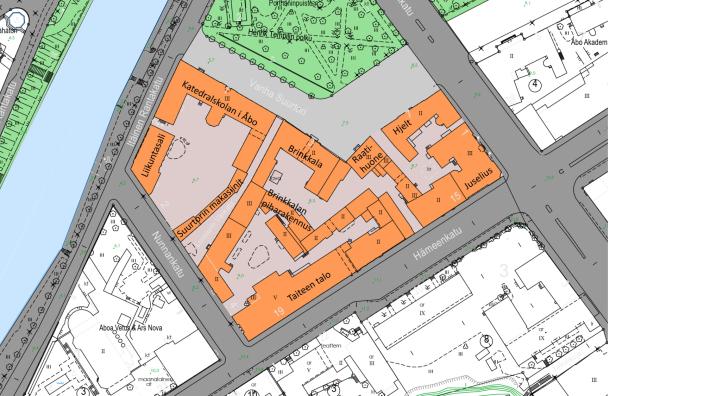
The City of Turku has launched a renovation project for the culturally and historically significant protected buildings at the Old Great Square, as the buildings have subsided more rapidly and unevenly over the past 15 years. In the town plan drawn up by Carl Ludvig Engel, the block at the Old Great Square is named the Elephanten block, and the renovation project is therefore known as Elephanten.
The project is exceptionally demanding, as the buildings form part of medieval Turku’s urban structure and conceal layers of medieval history, including underground cellars.
The aim of the project is to identify solutions that preserve the historical layers and unique cultural heritage, while also finding ways to reinforce the buildings’ foundations and prevent further subsidence.
The renovation work is carried out throughout the project in close cooperation with museum authorities. The planning process also takes into account the area’s active use, with efforts made to minimise disruption to operators and the general public.
Assessing the conditions and state of the foundations will require extensive archaeological excavations. The investigations will determine how extensive and demanding the renovation of the buildings in the Elephanten block will be.
Related content:

The Buildings at the Old Great Square
Over the years, the buildings surrounding the Old Great Square have hosted a wide range of activities, from a prison and a police station to a society house and a shirt factory. Once a centre of trade, justice and public events, the area has evolved into a focal point for cultural and art events and a lively place to meet. Explore the rich and varied history of the buildings.
A wooden town hall stood on the site of the current building as early as the 14th century. In the 18th century, Samuel Berner designed a two-storey Baroque-style town hall adorned with a clock tower. The town hall was damaged in the Great Fire of Turku in 1827, and in 1829 Pehr Johan Gylich designed what is now known as the Old Town Hall on the ruins of the fire-damaged building.
Over the centuries, the Old Town Hall has served as a prison, a private residence, a shirt factory and a police station. Today, the building houses exhibition spaces, a banquet hall and the Turku Art Lending Service.
Brinkkala Mansion, known as the site of the Declaration of Christmas Peace, originally served as the town residence of the master of Brinkhall Manor. The present Brinkkala Mansion was built in the 18th century by Josef Berner. Before the Great Fire of Turku, Brinkkala functioned as a high-end hotel, an official residence for the Governor General, and a venue for social gatherings. After the fire, Pehr Johan Gylich was responsible for the area’s reconstruction plans, and the building was taken into use as a police station.
In the 1980s, Benito Casagrande’s vision led to the development of the Old Great Square as a shared urban space for residents, and the restored Brinkkala Mansion was reopened in 1998. Today, its historic premises are available for rent, and the inner courtyard hosts pop-up shops, a book café, craft boutiques and galleries.
Hjelt Mansion is a city palace representing Russian-style Empire architecture, located on the edge of Turku’s Old Great Square. The building is already marked on a map from the 1740s, suggesting that it was likely renovated after the Great Fire of Turku using older structures. Hjelt Mansion was commissioned in 1830 by sea captain Fredrik Wilhelm Hjelt, with the Empire-style design created by Pehr Johan Gylich.
The building remained in private ownership until the 1930s, after which it was used by, among others, the police, the City of Turku's Library and Cultural Centre. Today, the building houses the Youth Information Centre as well as the Baltic Sea Offices.
Juselius House, designed by Karl Viktor Reinius in the Neo-Renaissance style, is named after its commissioner, Carl Fredrik Juselius. Completed in 1892 and known as the palace of the shirt manufacturer, the building is newer and better preserved than the other buildings surrounding the Great Square.
Inspired by 19th-century Italy, Juselius House has been used not only as a shirt factory but also as residential apartments and as premises for physicians and Social Services. Today, the basement level of Juselius Mansion is home to Restaurant Teini, continuing the tradition of café and restaurant Hansa, which opened in 1924.
