
The Music Centre Fuuga will open in autumn. During spring 2026, the concert hall has gotten a stage, wall panels, and a wooden acoustic reflector canopy suspended from the ceiling. The acoustics have already been tested on site. The concert hall’s sound is shaped by Finnish wood.
Successful concert hall acoustics are the result of both high-quality design and precise construction. Fuuga’s acoustic design has been carried out by leading international experts, but every stage of construction also plays a significant role – each element, its shape and exact installation directly affect how the concert hall ultimately sounds.
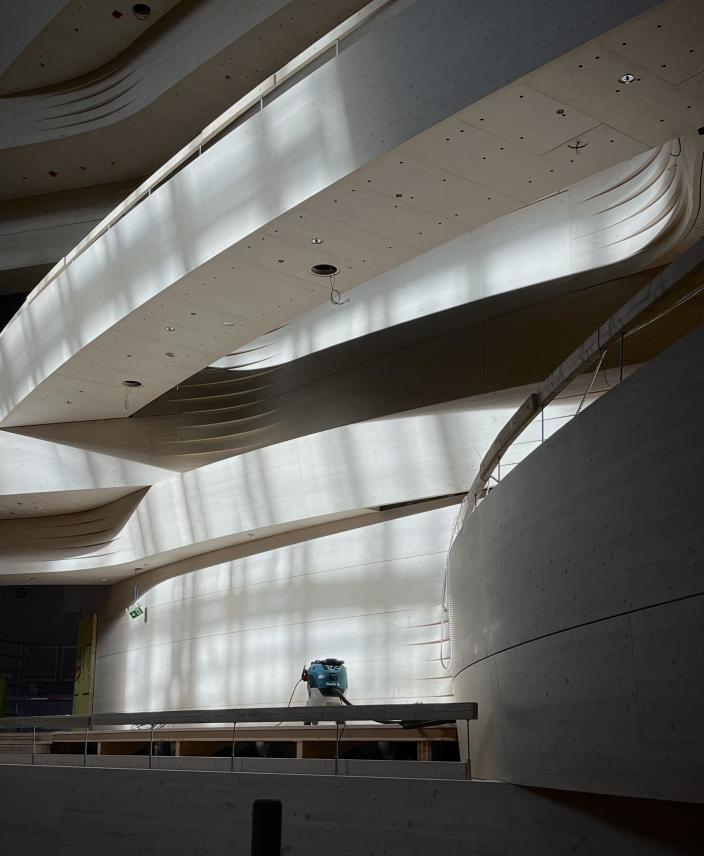
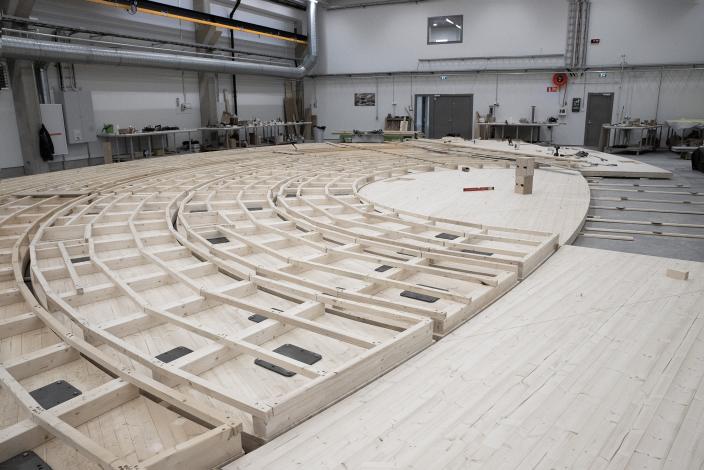
At the core of Fuuga’s acoustics is Finnish wood. The concert hall features over 300 unique spruce CLT wall elements, installed with millimetre precision. Together with other materials in the hall, they create a distinctive acoustic environment. The wall cladding has been manufactured by Raision Puusepät Oy, which has also produced the pine concert stage, the double-curved balcony fronts and the ceiling-mounted reflector canopy.
The concert hall seating is also made of wood. Acoustic performance takes into account factors such as upholstery, padding thickness, backrest height and the space beneath the seats. The acoustic properties of the chairs have been tested in laboratory conditions both with and without people, allowing their real impact on acoustics to be considered in the design. The audience area is the largest sound-absorbing surface in the hall. The venue will have approximately 1,300 seats. The chairs are manufactured by Piiroinen Oy from Salo.
Millimetre-precise Angles and Curves
The acoustic design of Fuuga’s concert hall is based on a modified shoebox model and carefully optimised curved surfaces. All structures in the concert hall – including balconies, wooden surfaces, long spans and fixing methods – have been designed to support acoustics. Openings behind the balconies are also part of the acoustic design.
The angles and curves of wall and ceiling surfaces, designed using ray-tracing methods, direct sound reflections so that the sound surrounds the listener evenly regardless of seating location.
Fuuga’s acoustic design is led by the Akukon & Kahle Acoustics consortium. The design team selected by the project alliance consists of the most experienced concert hall designers from Finland’s Akukon and Belgium’s Kahle Acoustics. The work has also been supported by Professor Tapio Lokki’s research group at Aalto University.
Reflections Are Tested During Construction
Acoustic designers monitor and supervise implementation during construction and support the site in delivering this acoustically demanding building. During the spring, they have tested, among other things, reflections from the balcony fronts.
– In early spring, we conducted a manual reflection test in the concert hall using lasers to ensure that the acoustically critical balcony fronts reflect sound in exactly the right direction and across a sufficiently wide area, says acoustician Sara Vehviläinen from Akukon.
– The results look good and promising, and all findings have been positive. Even though the hall was still unfinished, we were already able to confirm that the tested sound-reflecting structures perform exactly as designed. A highly skilled team has been involved, she adds.
Stage measurements were also carried out.
– These allow us to compare results with other similar concert halls. The measurements show, for example, how the stage in Fuuga responds to sound excitation, at which frequencies it absorbs and at which it resonates. Stage acoustics are an important part of the orchestra. In particular, the cello and double bass, which are in contact with the stage, provide strong feedback to the musician through resonance.
A Top-tier Hall Is Quiet
To achieve the best possible acoustics, unwanted noise must be eliminated. Silence is a fundamental requirement for a world-class concert hall, allowing even the most subtle nuances to be heard.
Sara Vehviläinen explains that background noise levels are kept extremely low through specialised solutions. This includes minimising the impact of ventilation, technical systems, and external noise through routing, mounting solutions, silencers, and enclosures. Precise guidelines have been defined for where all sound-generating equipment can be installed.
Care has also been taken to ensure that internal building noise does not enter the hall. This has been achieved through optimally placed acoustic movement joints, additional structures, and vibration and sound-isolating mounting solutions.

Music Surrounds the Listener
The placement of building services and other installations in Fuuga has also been designed so that nothing interferes with acoustic reflections.
– The goal is for Fuuga’s concert hall to be among the best in the world acoustically. In addition to a sufficiently long and balanced reverberation, the music should sound clear and strong and surround the listener so that they feel part of the concert – part of the music, says Vehviläinen.
She adds that the acoustics must support the musicians’ performance and feedback from the hall. The direction, quantity, delay, and strength of sound reflections must be precisely right. In the new home of the Turku Philharmonic Orchestra, the hall supports orchestral performance and is at its best with acoustic orchestral music.
Photos: Marko Kivistö