
Teaching children to read, write and count. Helping them grow and develop. Music, crafts and PE. Encouraging, motivating and inspiring pupils. Amanda Nurmi's school days are packed with activity.
Twenty-seven cheerful, chatty pupils return from break to class teacher Amanda Nurmi's classroom. Or, more accurately, to what is nowadays often called a learning space.
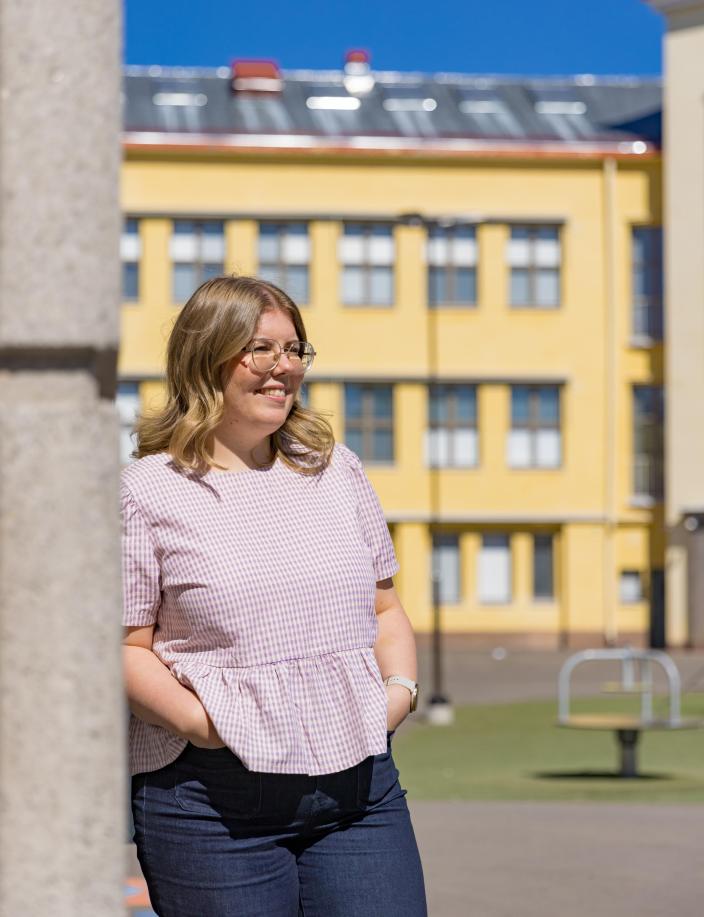
Now in her sixth year at the Nummi unit of Nummenpakka School, Amanda welcomes the children with warmth and quiet confidence. Within moments, the pupils are immersed in the day's activities.
For Amanda, becoming a teacher and educator felt like the most natural career choice.
– I was involved in Scouts and led different groups. I already knew what everyday life at school was like because my mother is also a class teacher.
Talented in many different ways, Nurmi seems made for the profession. Outside school, she enjoys running, cycling and playing football. She also knits, reads and bakes. She plays both the piano and the violin, and sings. On top of that, she teaches music to every primary year group.
Amanda's working day starts very early.
– I'm often at school shortly after seven to get the paperwork done because I try not to take work home with me. I love pottering around the classroom – it's time I get to myself.
A multicultural classroom
The Nummi unit is the local neighbourhood school for pupils from the Student Village, Nummi and Halinen areas. Amanda describes her Year 4 class as brave, positive, energetic and eager to learn.
– My class includes pupils from many different backgrounds. Together, they speak 15 different first languages.
Some pupils first attend a VALMO preparatory class for basic education before joining mainstream basic education.
Some pupils still have limited Finnish language skills, others are developing their skills, while some are native Finnish speakers. Some children are reading beginner books with syllable markings, while others are already reading Harry Potter books. Such a wide range of abilities presents challenges for the teacher and requires a thorough understanding of every pupil's individual needs.
– You have to adjust your expectations. You can't expect every child to achieve exactly the same things. Teaching requires differentiation, so different pupils may be working on different tasks, Nurmi explains.
As pupils return full of energy after the summer holidays, they need reminders about school routines.
– Children enjoy routines and clear ways of doing things. In fact, they look forward to them when school starts again in the autumn.
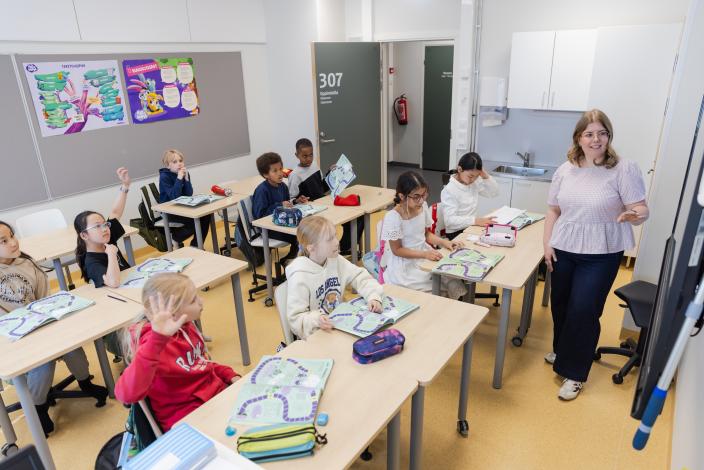
In this multicultural classroom, every pupil is given learning tasks that match their individual needs. Photo: Linda Svarfvar
Teaching life skills every day
Being a class teacher means teaching children everyday life skills every day.
– There isn't a single moment at school when you're not helping to raise children. Did you remember to say thank you when someone held the door open? Are you using your knife and fork properly? Did you put your chair on the table before leaving? When it comes to things like tying shoelaces or telling the time, families could perhaps take a little more responsibility.
Amanda feels that children today are often full of energy. Group and friendship skills are practised in the classroom every day.
– Waiting for your turn or settling down to concentrate on one thing can be very demanding for children. We also have to teach perseverance. You can't simply pour knowledge into a child's head – multiplication tables still have to be learned by heart.
– I'd like us to get back to the basics of schoolwork. For many children, it would be enough to focus on the fundamentals: reading, writing and maths. Those skills are still developing for many of them.
A good sense of humour goes a long way
– The sense of achievement in this job comes from the little things. You see the moment when something suddenly clicks for a child, or you manage to get the whole class so excited that everyone is fully engaged. Or perhaps you've been practising coming into the classroom, getting everything ready and sitting quietly, and then everyone succeeds. Those are the moments to take encouragement from, Amanda says.
Nurmi feels that teaching and working with children are valued. Many people see teaching as an exhausting profession. However, Amanda enjoys her work and does not find the work itself difficult.
– Of course, there are challenging situations with pupils and different social issues. Sometimes you wonder what the best way to respond is.
At Amanda's school, teachers work together to discuss challenges as they arise and find solutions. Support is available from the headteacher, colleagues and members of the school's pupil welfare team, including the school counsellor, psychologist and school nurse.
– We work together and try to approach many situations with a sense of humour. At our school, a good sense of humour goes a long way.
TEXT: LEA FROLOFF | PHOTOS: LINDA SVARFVAR
The article has been published in Finnish in Turkuposti 2, 2026.


