
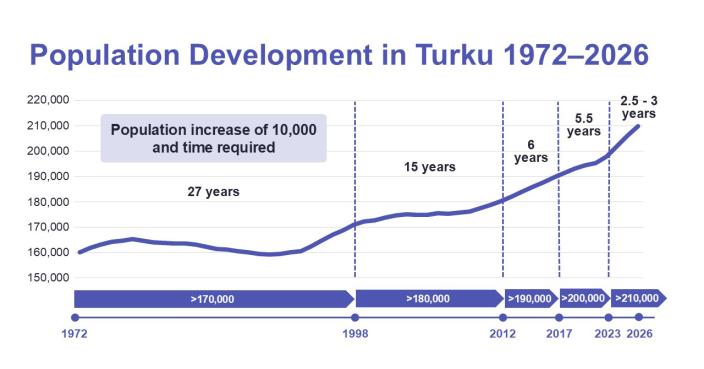
Turku’s central urban area is compact. And it is becoming even denser as the city’s population continues to rise rapidly. The growth is visible in intensive construction and new large residential areas that have been built in recent years next to the city centre.
According to the latest population forecast, Turku’s population is expected to grow by 40,000–59,000 residents between 2024 and 2040. Growth will focus particularly on the working-age population, supporting the city’s labour markets and vitality.
However, population growth does not mean the city will significantly expand outward. Growth is managed by densifying the urban structure.
The Strongest Growth Near the City Centre
Examples of urban densification include several new residential areas located close to the city centre, such as Kirstinpuisto, Pukkila, Herttuankulma, the Logomo area and Barkerin kulma. These former industrial, warehouse, or depot areas have been given a new life as residential neighbourhoods. In addition to their similar history, they share a short distance to the city centre.
Linnakaupunki, which includes Herttuankulma and Kirstinpuisto, is one of Turku’s fastest-growing residential areas. Housing for approximately 15,000 residents is planned there. This new urban district is already taking shape as a natural extension of the city centre. When the harbour rail line is relocated further north, Linnakaupunki will be even more closely connected to the centre.
Pihlajaniemi, being developed next to the former Heikkilä military area, also has good connections to the city centre. The new seaside district will accommodate more than 5,000 residents.

More Housing in the City Core
Turku’s city centre is also becoming denser. Additional construction supports the city’s sustainable growth.
In Aninkaistenmäki, the block containing the vocational school and the Concert Hall has received a new local detailed plan enabling two ten-storey residential buildings. One will be located in the centre of the block next to a new square, and the other towards Park Field. Seven- and eight-storey buildings may be constructed along Nahkurinkatu. The new housing will bring nearly 400 new residents to the area.
The plan protects both the Concert Hall and the school buildings located in the middle of the block and along Aninkaistenkatu. The Candolin service housing unit will be preserved.
New housing as well as office and commercial premises are also planned for the Herkules block along the Aura River at the corner of Martinkatu and Itäinen Rantakatu.
Apartment buildings are planned for the Turku Energia block along Linnankatu. The local detailed plan enables the construction of seven new apartment buildings and a parking structure.
Why Does the City Aim to Densify?
The goal is to create a sustainable foundation for urban living. Residents must be able to move around their home city in ways that minimise environmental impact. Therefore, housing is primarily built in areas that already have services and good public transport connections.
Secondly, new residential areas are developed where infrastructure is already in place and natural areas do not need to be cleared. Former warehouse and industrial sites, where activities have declined and land has become available, are well suited for redevelopment.
Encouraging Sustainable Mobility
Short distances, nearby services and efficient public transport encourage climate-friendly mobility. Turku’s size and urban structure make it ideal for cycling: over 90% of residents live within a 30-minute cycling distance from the Market Square.
New housing is primarily zoned within approximately a three-kilometre radius of the city centre. This sustainable urban zone includes, for example, the new City Garden area in Peltola and the nearby Petrelius area along Peltolantie.
Significant development is also planned for the Science Park area in Kupittaa and Itäharju, where up to 10,000 new homes are planned in the coming decades. In the long term, the area is expected to accommodate 18,000 jobs, 16,000 residents and investments of up to 4 billion euros. Construction is expected to continue into the 2060s.
The transforming Itäharju area is also a former industrial and warehouse district. Densification is also taking place in areas well served by public transport, such as Länsikeskus, Runosmäki, Varissuo and Skanssi.
Skanssi, located about four kilometres from the city centre, is an example of a sustainable neighbourhood, where special emphasis has been placed on public transport, cycling, and walking. Housing for approximately 7,000 residents is planned there.
Not Only Apartment Buildings
Turku continues to expand opportunities for residents to live in low-density housing areas as well. The strongest growth direction is on the island of Hirvensalo, where most growth before 2030 will be directed. The partial master plan enables approximately 15,000 new residents to move to the island.
Satava and Kakskerta are also growing. A partial master plan has been approved, enabling zoning for detached housing in eastern Satava and development in other parts of the islands.
From the perspective of detached housing plots, another important growth direction is northern Turku. In Jäkärlä, development is visible in the Vakiniittu and Koskennurmi areas. New plots are also planned for the Kaila area south of Tampereentie.
Turku offers diverse housing options. As the city centre and surrounding areas become denser, other areas can develop more spaciously.
Related content:
