
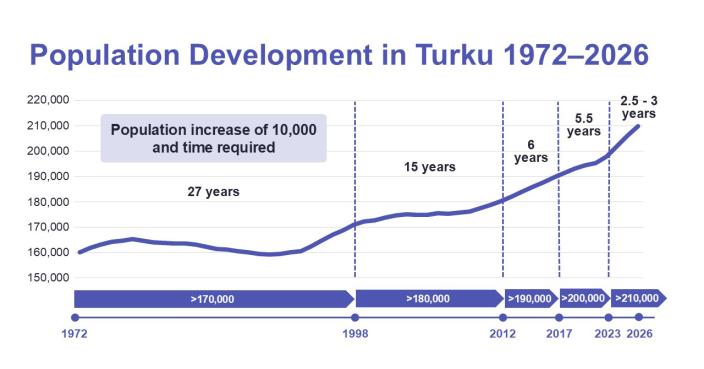
The population growth of Turku has been exceptionally rapid during recent years. Turku has gained 10,000 residents in just the last 2.5 years. According to information published by Statistics Finland on March 24, the population of Turku was 210,021 by the end of February.
Statistics Finland has retroactively corrected and specified the preliminary data of the municipalities' population. Based on the revision, the population of Turku has not quite yet exceeded the 210,000 mark.
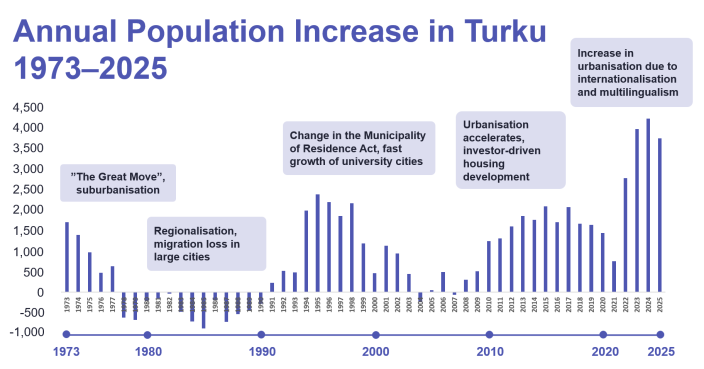
Over the past four years, the population of Turku has grown each year more than at any point in over five decades. Growth has clearly exceeded earlier population forecasts.
Turku’s population surpassed the long-anticipated milestone of 200,000 residents in August 2023. The next round figure, 210,000, was reached this February — just 2.5 years later. The acceleration of growth is illustrated by the fact that the increase from 170,000 to 180,000 took 27 years, while the rise from 180,000 to 190,000 took 15 years.
– Exceeding the 210,000-resident mark reflects Turku’s strong attractiveness and the fact that an increasing number of people want to build their lives here, says Mayor Piia Elo.
– At the same time, it highlights the importance of forward-looking planning in city decision-making and service development. We must ensure that services, housing, and mobility evolve alongside growth and support the smooth everyday life of our residents. We have already responded to this growth through measures such as new schools and daycare centres, zoning of residential areas, and plans for a higher-capacity public transport solution to support urban development.
We must ensure that services, housing, and mobility evolve alongside growth.
Previous, though more moderate, peaks in Turku’s population growth occurred in the late 1990s and the 2010s. In the 1990s, a reform of the Municipality of Residence Act allowed students to register their place of study as their municipality of residence, increasing the number of higher education students in Turku. In the 2010s, urbanisation accelerated more broadly, supported in part by investor-driven housing production.
Turku’s Growth Is Driven by Migration Attractiveness
In 2025, Turku’s population growth relative to its size was higher than in other large and medium-sized Finnish cities. Current growth is driven by migration, both domestic and international.
The volume of immigration to Turku has been at a record level over the past three years. In addition, net internal migration reached its highest level since 1995 in 2025. This aligns with a migration willingness survey published last year by Taloustutkimus, according to which Turku ranks among the three most attractive municipalities in Finland, alongside Tampere and Helsinki.
– Approximately 30 per cent of Turku’s net internal migration comes from multilingual residents, meaning secondary migration of immigrants within Finland. From an economic perspective, it is positive that we recorded a slight net gain of employed residents from both abroad and within Finland. Students also continue to play a significant role. This is visible in the statistics as a peak each August and September when studies begin, says Strategy Director Timo Aro.
Population growth in Turku has been relatively balanced across age groups. The city gains significant domestic net migration from young people aged 15–24, and international migration across all age groups, particularly among young adults and children.
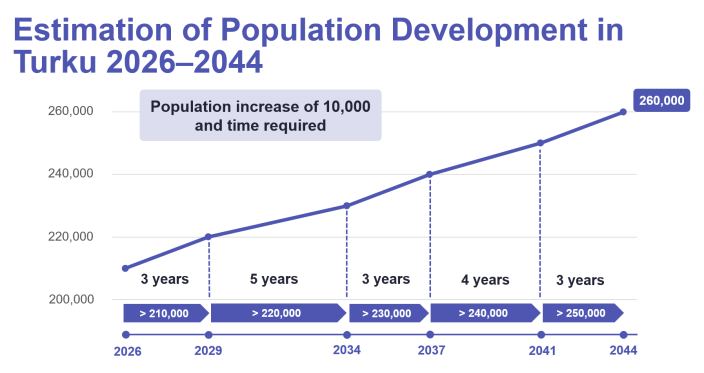
Population growth in Turku is expected to remain strong in the coming years, although not at quite the same pace as the one seen most recently.
– We continuously produce up-to-date information on population development and related phenomena, as well as other key changes in the operating environment, to support planning, decision-making and managed growth. Our aim is to ensure that services and investments respond to the real needs of a growing city, Aro concludes.
Information on the population, vitality, employment, tourism, and housing is published four times a year in the Turun muutoksen tuulet report (in Finnish).
In addition, a new report diving into the phenomena of population development has been published: Turun maahanmuuton tilannekuva (in Finnish).